
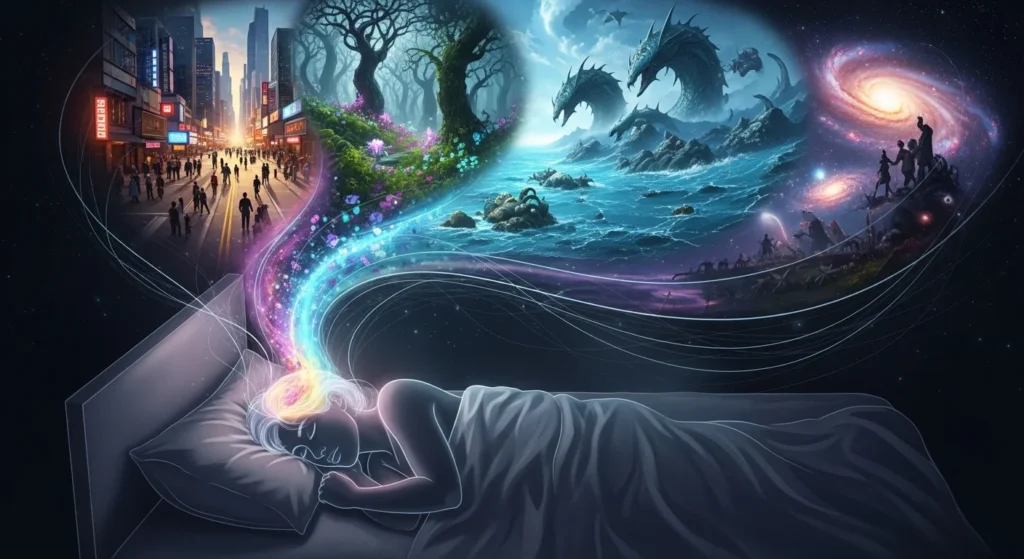
Have you ever woken up from a dream and wondered, “Was that really just my imagination?” Many people search “are dreams alternate realities” because our dreams can feel astonishingly vivid, emotional, and sometimes even prophetic. Whether it’s flying above mountains, meeting someone who doesn’t exist, or exploring a world that defies logic, dreams can feel like glimpses into another dimension. Today, we’ll dive deep into this intriguing question and explore the fascinating role dreams play in our lives.
Dreams aren’t just random flashes of imagination—they connect with our subconscious, emotions, and even social experiences. Understanding whether dreams are alternate realities can not only fuel your curiosity but also enrich your conversations, spark creativity, and even inspire new ways of thinking about the world. So, let’s take a journey into the dream world, where reality and imagination blur in the most mesmerizing ways. 🌙✨
Are Dreams Alternate Realities According to Science?
“If dreams are alternate realities, then every nap is a new universe.” 🌌
“Science says dreams are your brain’s playground—imagine it as an alternate reality simulator.” 🧠
“Neuroscientists reveal that dreams help process memories—maybe in a parallel reality!” 🔬
“Dreams mimic life, but in a secret alternate dimension where logic takes a holiday.”
“Lucid dreaming: proof that you can consciously enter your own alternate reality.” 🌙
“Some studies suggest dreams can simulate real-world problem-solving.”
“Your brain doesn’t distinguish between vivid dreams and reality—so maybe they’re mini alternate worlds.”
“Dreams are emotional simulations of life, hinting at alternate realities inside your mind.” ❤️
“REM sleep is the portal; your dreams are the gateway to other realms.”
“Ever dreamt something impossible yet felt real? That’s the alternate reality effect.”
“Some scientists call dreams ‘virtual realities created by the mind.’” 🕹️
“Dreams can combine memories and imagination—like a parallel version of your life.”
“When you dream, your brain runs a secret alternate-reality experiment.”
“Dreams often predict emotions, giving a glimpse into future alternate scenarios.”
“Some argue that dreams are simulations where you rehearse alternate choices.”
“In dreams, physics and time bend, creating alternate realms in your subconscious.”
“Dreams can feel more vivid than waking life—an immersive alternate reality.”
“Lucid dreamers can interact with their dream reality consciously.”
“Even recurring dreams create consistent alternate timelines in your mind.”
“Maybe every night we live parallel lives—we just forget them by morning.”
Spiritual Perspectives: Are Dreams Alternate Realities?
“Many traditions see dreams as glimpses into other planes of existence.” ✨
“In some cultures, dreams are messages from alternate spiritual worlds.”
“Shamans use dreams to explore hidden realities beyond the physical world.” 🌀
“Lucid dreaming can be a spiritual practice of visiting alternate realities consciously.”
“Dreams may connect us to the collective unconscious, an alternate shared reality.”
“Prophetic dreams are considered windows into alternate timelines.”
“Some believe souls travel in dreams, exploring parallel spiritual worlds.”
“Astral projection in dreams is thought to access alternate planes of existence.”
“Dreams can reveal hidden truths that reality often hides.”
“Ancient texts often describe dreams as gateways to unseen worlds.”
“Dreaming about ancestors may be visiting alternate dimensions of consciousness.”
“Meditation and dream journaling help explore spiritual alternate realities.”
“Dream symbols act as guides through alternate spiritual realms.”
“Certain dreams can heal emotional wounds by replaying alternate scenarios.” 💖
“Dreams often combine past lives, present life, and alternate realities.”
“Shamanic dreams are like blueprints of otherworldly experiences.”
“Dreams are a bridge between physical and non-physical realities.” 🌌
“Some cultures treat dreams as sacred glimpses into higher-dimensional realities.”
“Spiritual traditions suggest dreams teach lessons from alternate realms.”
“Perhaps every dream is a mini-voyage into unseen realities.”
Lucid Dreaming as an Alternate Reality Adventure
“Lucid dreams let you steer your dream reality like a cosmic GPS.” 🌠
“Consciously controlling dreams is like hacking an alternate universe.”
“Lucid dreaming proves the mind can explore realities beyond waking life.”
“In lucid dreams, you can fly, travel, or even meet yourself in parallel worlds.”
“Dream journals help map your personal alternate reality landscapes.” 📝
“Meditation before sleep amplifies the chance of alternate reality dreams.”
“Reality checks during the day make lucid dreaming easier.”
“Lucid dreaming can be fun, playful, and enlightening—your personal alternate reality.”
“You can practice skills in a lucid dream alternate reality.”
“Lucid dreams can merge your subconscious and conscious reality creatively.”
“Some people experience recurring lucid dreams in the same alternate world.”
“Lucid dreams are the playgrounds of your mind’s infinite realities.”
“In lucid dreaming, you can test different choices without real-world consequences.”
“Flying in a lucid dream is your brain’s alternate reality reward system.” 🕊️
“Some lucid dreams feel more vivid than waking life—a true alternate existence.”
“Lucid dreaming can help overcome fears by rewriting alternate scenarios.”
“You can consciously explore dream landscapes that defy physics.”
“Dream mentors or guides often appear in lucid dream realities.”
“Lucid dreaming is like being the director of your personal multiverse.” 🎬
“Lucid dreams remind us that reality is flexible—maybe dreams are real, too.”
Dreams in Literature and Pop Culture as Alternate Realities
“Stories often use dreams as portals to alternate realities.” 📚
“Movies like Inception explore dreams as layered alternate worlds.”
“Fantasy novels often treat dreams as hidden dimensions.”
“Dream sequences can reveal a character’s alternate reality choices.”
“Cartoons sometimes play with dream logic as parallel universes.”
“Shakespeare occasionally hinted at alternate realities through dreams.”
“Dream diaries inspired many modern novels.”
“Comics explore alternate realities with dream-inspired plots.”
“Dream symbolism in literature reflects alternate life possibilities.”
“Sci-fi often blurs the line between dream worlds and reality.”
“Movies show characters learning life lessons in dream realities.”
“Dreams in literature often reveal what’s hidden in the waking world.”
“Some novels describe recurring dreams as alternate timelines.”
“Dream-inspired plots allow authors to bend the rules of physics and logic.”
“Pop culture shows fascination with ‘what if’ scenarios in dreams.”
“Some games simulate dream-like alternate realities for players.”
“Stories often depict dreams as testing grounds for alternate choices.”
“Dream imagery adds layers of depth to storytelling.”
“Alternate realities in literature spark philosophical debates about consciousness.”
“Dreams in pop culture often reflect our subconscious multiverse.”
How Recurring Dreams Suggest Alternate Realities
“Recurring dreams may hint at unresolved alternate scenarios.”
“Repeated dream themes could be a mental parallel universe replay.”
“Recurring nightmares feel like warning messages from another reality.” 😱
“Recurring pleasant dreams create dream worlds we keep visiting.”
“Patterns in recurring dreams reveal subconscious alternate timelines.”
“Recurring dreams may reflect alternate outcomes of past decisions.”
“Lucid recurring dreams let you experiment with different realities.”
“Some psychologists interpret recurring dreams as simulations of parallel lives.”
“Recurring dreams may help emotional processing in an alternate reality context.”
“Patterns in dreams can guide conscious life choices.”
“Recurring dreams often feel more vivid than random ones.”
“Dreams repeating the same environment suggest a persistent alternate world.”
“Recurring dreams may involve other characters from alternate versions of our life.”
“Repeated dream settings act like familiar parallel universes.”
“Recurring dreams can feel like visiting a second home in another reality.”
“Some recurring dreams provide creative inspiration.”
“Recurring dreams may indicate unresolved emotions replayed in alternate reality simulations.”
“People often remember recurring dreams more clearly.”
“Recurring dreams can offer insights into the subconscious multiverse.”
“Recurring dreams may be the closest we get to personal parallel universes.”
Nightmares: The Dark Side of Alternate Realities
“Nightmares are the horror movies of our dream alternate realities.” 😈
“Fear in nightmares feels real because your brain treats dreams like reality.”
“Nightmares can explore worst-case alternate scenarios.”
“Some nightmares reveal subconscious anxieties in parallel life simulations.”
“Recurring nightmares may suggest unresolved alternate conflicts.”
“Nightmares can be controlled in lucid dreaming—rewrite your alternate reality!”
“Nightmares often exaggerate real-life fears in alternate dream worlds.”
“Facing fears in nightmares may prepare you for waking life challenges.”
“Nightmares may show what could happen in different life choices.”
“Some nightmares inspire real-life problem-solving.”
“Nightmares are a safe space to experience danger in another reality.”
“Nightmares sometimes act as mental rehearsals.”
“They remind us that alternate realities can be thrilling and terrifying.”
“Nightmares are emotional simulations that feel like real alternate universes.”
“Some nightmares reveal hidden aspects of our personality.”
“Facing nightmare scenarios can increase courage in waking life.”
“Nightmares often combine memory and imagination in surreal alternate worlds.”
“Nightmares can teach lessons from the subconscious.”
“Even in nightmares, you can find alternate solutions.”
“Nightmares confirm that the dream world is as real to the mind as waking life.”
Fun Dream Experiments to Explore Alternate Realities
“Keep a dream journal to track your alternate reality adventures.” 📝
“Try reality checks during the day to trigger lucid dreams.”
“Set dream intentions before sleeping.”
“Meditate to enhance awareness of your dream world.”
“Experiment with dream characters—they may guide you through alternate worlds.”
“Play music or scents while sleeping to influence dream content.”
“Observe recurring dream patterns.”
“Try waking up and going back to bed to continue a dream.”
“Read dream interpretation books for insights into alternate realities.”
“Explore shared dreaming theories with friends.”
“Keep a sketchbook for dream landscapes.”
“Use visualization to enter desired dream realities.”
“Lucid dream training apps may help control alternate realities.”
“Dream meditations can stabilize dream awareness.”
“Try sleep cycles that increase REM periods.”
“Share and compare dreams to explore collective alternate realities.”
“Document emotions in dreams—they reveal subconscious realities.”
“Set small challenges in dreams to test alternate problem-solving.”
“Combine multiple sensory experiences in lucid dreams.”
“Treat dreams as personal VR experiences of alternate realities.” 🎮
How Dreams Influence Real-Life Choices and Alternate Reality Thinking
“Dreams can inspire real-world creativity.” 🎨
“They often help solve problems you couldn’t figure out awake.”
“Dreams influence decisions by simulating possible outcomes.”
“Recurring dreams may hint at life paths in alternate realities.”
“Lucid dreams let you rehearse real-life scenarios.”
“Dreams can shape confidence by testing alternate outcomes.”
“Nightmares can motivate avoidance of bad choices.”
“Dream insights often emerge in waking life unexpectedly.”
“Creative breakthroughs often happen after vivid dreams.”
“Dream journaling improves self-awareness and alternate reality reasoning.”
“Some inventors credit dreams with real-world innovations.”
“Athletes practice moves in dream simulations.” 🏀
“Dreams can guide relationships by exploring alternate interactions.”
“Decision-making can be enhanced by reflecting on dreams.”
“Alternate dream realities let you experiment safely.”
“Dreams often encourage exploring new perspectives.”
“Dreams may reveal hidden desires and fears.”
“They can enhance problem-solving skills.”
“Dreams expand the mind’s concept of what is possible.”
“Treating dreams as alternate realities makes life more imaginative.”
FAQs
1. Are dreams really alternate realities?
Dreams are not alternate realities in the physical sense, but they are alternate mental realities. Your mind simulates experiences using memories, emotions, and imagination, making them feel vivid and immersive.
2. Can lucid dreaming prove dreams are alternate realities?
Lucid dreaming shows that you can consciously interact with your dream world, creating personal alternate realities, though not physically real. It’s proof of the mind’s ability to simulate complex experiences.
3. Why do some dreams feel more real than waking life?
Dreams can trigger emotions and sensory experiences similar to waking life. The brain processes dreams using the same neural pathways, making the experience feel as tangible as reality.
4. Do recurring dreams suggest parallel universes?
Recurring dreams reflect repeated patterns in the subconscious. While they don’t prove actual parallel universes, they simulate alternate scenarios of your life and choices.
5. How can dreams improve creativity and problem-solving?
Dreams allow the mind to explore scenarios without real-world consequences. They inspire creativity, rehearse decisions, and provide new perspectives, often leading to insights you wouldn’t gain while awake.
Conclusion
Dreams may not be literal alternate realities, but they are alternate dimensions of the mind—vivid, immersive, and full of untapped potential. From lucid adventures to recurring scenarios, from nightmares to playful explorations, our dreams shape creativity, decision-making, and self-awareness. By paying attention to dreams, journaling them, and even practicing lucid dreaming, you can unlock your personal multiverse every night. So the next time you wake up from a mind-blowing dream, remember: your subconscious might just be giving you a sneak peek into another reality. 🌌✨